Hi all - I subscribe and pay for Elissa Malespina's Substack newsletter about AI, so I will only share the portion that is free, but she responds to the loss of the CIA Factbook which was brought up on the list-serv the other day.Elissa is an outstanding school librarian and intellectual freedom advocate from New Jersey. Here is the page to join. I think you will find it well worth it.Here are a couple of replacements that she suggests (there are more in the paid version) including the purpose for instructional use:Library of Congress Country Studieshttps://www.loc.gov/collections/country-studies
UNdata
https://data.un.orgCASL is hosting Elissa on March 9 at 5pm - you don't want to miss out on this TechIT event. Register at ctcasl.org.Have a terrific Thursday!Jenny
View in browser
Bonus Content - Just for my paid subscribers! Thank you for your support!
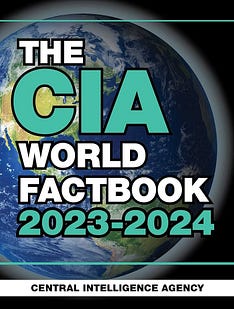
When the CIA World Factbook Disappears
How the loss of a free reference tool reshapes student research and access
READ IN APP
Editor’s Note
The CIA World Factbook quietly ended in early 2026. There was no transition plan for schools. No replacement resource announced for educators. For students and librarians, the impact was immediate. This special edition explains what we lost, why it mattered so deeply for equity and access, and what to do now that one of the most widely used free global reference tools is gone.
Why the CIA World Factbook Mattered
For more than sixty years, the CIA World Factbook served as a stable, public reference source for country-level information. It was not meant to be exhaustive. Its value came from consistency.
Every country profile followed the same structure. Geography. Population. Government. Economy. Culture. Basic statistics. That predictability made it uniquely suited for education.
Equally important, it was free and public domain. No subscriptions. No passwords. No usage limits. For schools and families without access to paid databases, it functioned as a rare equalizer.
It was often the first source students used, not the last. That distinction matters.
What Students Lose When It Disappears
For students, particularly in middle school through early college, the Factbook served as a research on-ramp.
It allowed students to:
Build background knowledge quickly
Compare countries using standardized categories
Complete research assignments without paid access
Learn how to extract information from a structured reference
Without it, students are pushed into a fragmented research environment. Data is now spread across multiple platforms, each with different definitions, update cycles, and interfaces.
This increases the difficulty of basic research assignments overnight. Students who already struggle with research skills feel this loss first.
The Access Gap We Cannot Ignore
For many students, schools, and public libraries, the CIA World Factbook was not a convenience. It was the only reliable option.
Not every school library can afford international databases. Not every public library licenses global economic or demographic tools. Many students complete research at home or outside institutional systems entirely.
Country and culture reports are among the most common assignments in K–12 education. World geography. Global history. Cultural comparison projects. ESL and world language classes. These assignments persist because they are accessible entry points into research.
The Factbook made them possible without requiring paid access.
When it disappears, students are often left with:
Ad-supported websites of uneven quality
Tourism-focused cultural portrayals
AI-generated summaries with unclear sourcing
Outdated or oversimplified secondary sites
This is where equity becomes concrete. When free, authoritative reference tools vanish, research becomes harder precisely for those who already have fewer supports.
The Cultural Impact on Student Research
Country reports are often a student’s first encounter with a place they have never visited.
The tone of the Factbook mattered. It emphasized structure over stereotype. It avoided sensationalism. It presented countries consistently rather than hierarchically.
Without that baseline, students are more likely to encounter:
Politically biased descriptions
Oversimplified cultural generalizations
Content optimized for clicks rather than accuracy
This changes not just research quality, but how students learn to see the world.
What This Means for Librarians and Educators
The end of the Factbook shifts invisible labor onto librarians and teachers.
We now have to:
Teach students how to triangulate multiple international data sources
Explain why population or GDP figures differ across platforms
Help students evaluate the authority of unfamiliar datasets
Redesign assignments that quietly depended on one free source
For years, librarians used the Factbook strategically to design research assignments that did not require logins or subscriptions. Its loss forces a reckoning with how much of our curriculum relied on public infrastructure we did not control.
The Hidden Impact on Databases and AI Systems
The effects extend beyond classrooms.
Many educational databases, nonprofit reports, journalism explainers, and AI systems relied on Factbook data directly or indirectly.
When a foundational dataset disappears:
Update pipelines break
Historical continuity becomes harder to maintain
Secondary tools freeze outdated values or substitute weaker sources
Errors propagate quietly across systems
Students may not know the Factbook is gone, but they will encounter its absence through inconsistent data and contradictory summaries.
What Comes Next for Country and Culture Research
The loss of the CIA World Factbook does not leave a neat gap that can be filled with a single replacement. Instead, it forces educators and librarians to rethink how country and culture research is taught, scaffolded, and supported, especially in settings without access to paid databases.
Some students will adapt quickly. Others will not. The difference will come down to whether adults intentionally redesign research instruction or quietly hope students will figure it out on their own.
That is where libraries matter most.
Preview of the Paid Section
In the section below, I move from analysis to action.
The paid portion of this special edition lays out practical, classroom-ready guidance for replacing the CIA World Factbook without increasing inequity or lowering research standards. It is written for librarians and educators working in real conditions, including schools and communities without deep database budgets.
What follows includes:
A clear strategy for redesigning country and culture assignments
Free, authoritative replacement sources organized by grade level
Guidance on teaching students how to handle conflicting data
Explicit AI-use boundaries for country research
Librarian-centered approaches that protect access and equity
If the CIA World Factbook once carried the weight of your country research instruction, this section is designed to help you rebuild that structure intentionally.
What to Do Now That the CIA World Factbook Is Gone
The end of the CIA World Factbook is disruptive, but it does not have to be destabilizing.
What it does require is a shift away from a single default source and toward a deliberate research ecosystem, one that balances access, authority, and instruction.
This section focuses on what works now.
Closing Thoughts
The CIA World Factbook was not just a website. It was part of the public knowledge infrastructure that made global research possible without a credit card.
Libraries did not cause its disappearance.
But libraries will determine how students learn to respond to it.Handled intentionally, this moment can strengthen research instruction.
Handled passively, it will widen gaps.That choice belongs to us.
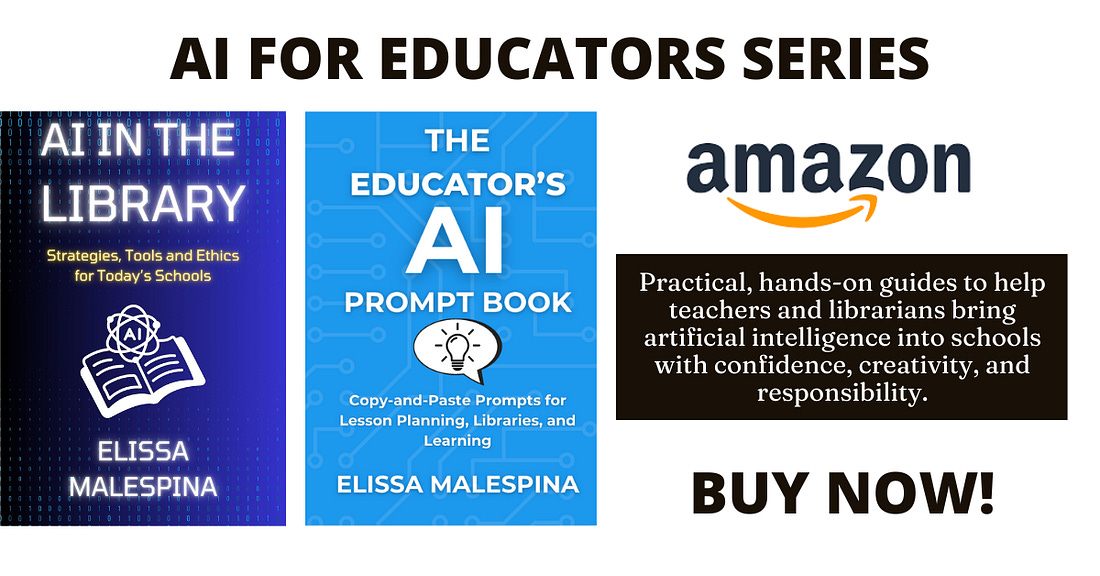
📘 The AI For Educators Series
Written by Elissa Malespina—now available in eBook and paperback!
AI in the Library: Strategies, Tools, and Ethics for Today’s Schools
NEW - The Educator’s AI Prompt Book: Copy-and-Paste Prompts for Lesson Planning, Libraries and Learning.
Portions of this newsletter are enhanced using AI-powered tools, with human review ensuring accuracy and quality.
Thank you so much for your support!
Like
Comment
Restack
© 2026 Elissa Malespina
South Orange NJ
Unsubscribe
--(she/her/hers)ALA/AASL, ISTE, CASL, CSTA memberCASL Immediate Past-PresidentFB: @mrslussierslibrary, Twitter: @jluss, Instagram: mrslussierlibrary
-----
Jenny Lussier
Library Media Specialist
Brewster Elementary School
Visit us at: Brewster website
CONFIDENTIALITY: This email (including any attachments) may contain confidential, proprietary and privileged information, and unauthorized disclosure or use is prohibited. If you received this email in error, please notify the sender and delete this email from your system.
_______________________________________________
CASL-L mailing list
CASL-L@mylist.net
https://mylist.net/listinfo/casl-l