Melissa

http://www.msthomsbookitis.weebly.com
From: The AI School Librarian Newsletter <aischoollibrarian@substack.com>
Date: Thu, May 7, 2026 at 7:13 AM
Subject: The Quiet Collapse of the AI Tutor Dream
To: <melissa_thom@whps.org>

Like what you are seeing? Subcribe to get full access! The Quiet Collapse of the AI Tutor DreamWhat Khanmigo reveals about why AI alone won’t fix learning
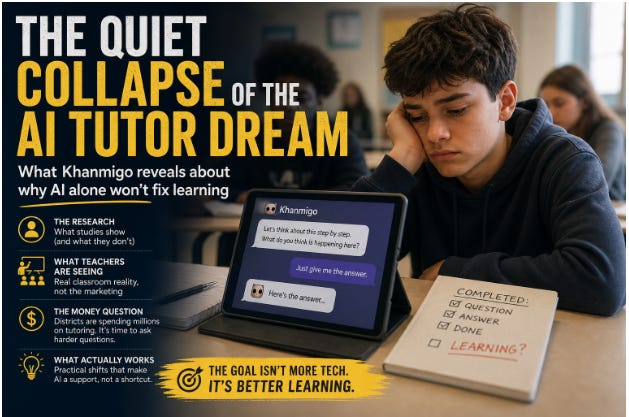
For the past two years, we have been told that AI tutors would change everything. Students would have constant support. Learning would be personalized. Gaps would close. And for a moment, it felt possible. Then something quieter happened. Students stopped using them. What Happened to KhanmigoWhen Sal Khan introduced Khanmigo through Khan Academy, the vision was clear. This would not be a chatbot that gives answers. It would guide students through thinking. A tutor that prompts instead of solves. A system built on questions, not shortcuts. But more recently, that vision has run into a classroom reality. Students often did not engage with it in meaningful ways. In many schools, it became a tool that was available but not deeply used. That is not a technical failure. It is something deeper. A Classroom Moment We Should RecognizeA student opens an AI tutor, pastes the question, and waits. The tool responds with guiding prompts. The student skips them. They push for a more direct answer, copy what they need, and move on. The assignment gets completed. The learning does not. That moment is not rare. It is the pattern that is happening all the time in our classrooms. The Problem No One Wanted to NameAI tutors depend on behaviors many students are still developing.
Khanmigo’s design assumes students will engage in that kind of thinking. Many do not. And without that engagement, the system has nothing to work with. What the Research Actually SaysThe evidence is more consistent than the headlines. Studies show AI tutors can:
This aligns with established approaches like formative assessment and mastery learning. But the same research raises concerns. Students using AI tools often show:
In some studies, students completed tasks more successfully with AI, but performed worse on assessments without it. That gap matters. What Teachers Are Actually SeeingIn classrooms, AI tutors are not replacing instruction. They are being repositioned. Teachers are using them:
And something else is happening. Assignments are changing. If AI can complete the task easily, the task is being reconsidered. If AI can complete the assignment, the assignment is measuring output, not understanding. The Equity Issue We Cannot IgnoreAI tutors do not impact all students in the same way. Students who already have strong learning habits tend to benefit the most. Students who struggle with motivation, reading comprehension, or executive functioning often disengage or misuse the tool. Access is not the barrier anymore. Effective use is. Without intentional support, AI risks widening gaps rather than closing them. A Necessary CounterpointSome will argue that students simply need more time with AI tutors. That with continued exposure, they will learn to use them effectively. Time alone is not enough. Without explicit instruction and intentional design, students tend to reinforce the same patterns. They look for faster answers instead of deeper understanding. More access does not automatically lead to better learning. The Money Behind the AI Tutoring PushAcross the country, districts are spending heavily on tutoring. Much of that funding accelerated during pandemic recovery, with a focus on closing learning gaps quickly. High-dosage tutoring became a priority, and vendors moved quickly to meet that demand. Now AI tutoring tools are entering that same space. The question is no longer whether we can provide tutoring at scale. The question is whether the tutoring we are funding actually leads to learning. Because the research is clear on one point. Effective tutoring is not just access to help. It depends on:
AI can support parts of that. It does not replace it. If districts are investing in AI tutoring as a cost-saving measure or a scalable substitute, we need to be more precise in our expectations.
Those are different outcomes. And they require different tools. If we are going to invest in tutoring at scale, we need to be just as serious about how that tutoring works as we are about how much we are spending. So Did AI Tutors Fail?No. But the idea behind them did. The belief that access to an AI tutor would naturally lead to better learning outcomes is breaking down. Because learning is not just about access to help. It is about how that help is used. The Line We Need to Be Honest AboutWe did not overestimate AI. Why This Matters Right NowThis is not just about one tool. It is about a broader assumption that keeps showing up in education technology. If we build something powerful enough, students will use it well. That assumption has never held up. AI just makes the gap more visible. A Note on Data and PrivacyAI tutors rely on student interaction data to function. Schools need to be asking clear questions about:
Not all tools meet the same standards, and this cannot be an afterthought. Preview: What Comes Next (Paid Section)If AI tutors are not the solution, then what is? What should independent work look like now? What does practice look like in an AI-rich classroom? And how do we design learning that cannot be outsourced to a tool? The answers are already emerging. But they require a shift many schools have not fully made yet... Continue reading this post for free in the Substack app
© 2026 Elissa Malespina
|