---------- Forwarded message ---------
From: The AI School Librarian Newsletter <aischoollibrarian@substack.com>
Date: Fri, Jul 17, 2026 at 10:06 AM
Subject: The AI School Librarian’s - AI Ed News Brief
To: <pia@ledina.com>
View in browser
Bonus Content - Just for my paid subscribers! Thank you for your support!
The AI School Librarian’s - AI Ed News Brief
7/17/26- Timely updates. Curated for educators. Delivered to your inbox
READ IN APP
The AI School Librarian Newsletter —
Weekly News Brief
Curated by Elissa Malespina | July 17, 2026
Weekly updates for educators, librarians, and school leaders navigating the fast-moving world of AI.
This week’s developments show that schools are moving from awareness to accountability.
States are releasing AI guidance. Districts are trying to turn broad recommendations into usable policy. Researchers are mapping how uneven school AI policies already are. Companies are releasing educator-facing AI tools. At the same time, students are using AI for homework at high rates, colleges are struggling with assessment, and watchdog groups are warning that AI search is not ready to be treated as a trusted student research tool.
For school librarians, the pattern is clear. AI literacy is not only about using a chatbot. It is about understanding how information is produced, how tools shape answers, how students document their work, and how schools protect learning when answers are easy to generate.
Policy & School Governance
Illinois issues AI guidance for schools, written with help from AI
Capitol News Illinois | July 15, 2026
The Illinois State Board of Education released a 409-page guidance document to help schools and districts make decisions about artificial intelligence in classrooms and school operations. The guidance includes a disclosure that AI tools such as ChatGPT, Claude, and Gemini were used in developing some of the content.
Read more here:
https://capitolnewsillinois.com/news/illinois-state-board-of-education-issues-ai-guidance-written-with-help-from-ai/Why this matters:
The disclosure itself is important. It models one of the clearest expectations schools should be teaching: if AI is used in meaningful work, say so clearly and explain how.Library Lens:
AI disclosure should be treated as part of research ethics, authorship, and citation. Students need models for explaining where human judgment appears in AI-assisted work.The national AI policy landscape in K-12 remains uneven
EdSurge | July 13, 2026
EdSurge published a study examining AI policy across 122 districts and schools in 38 states. The analysis found that many districts are still operating reactively, and that state guidance does not always make its way into local policy. The study also found that most policies speak to students more than systems.
Read more here:
https://www.edsurge.com/news/study-the-national-ai-policy-landscape-in-k-12-educationWhy this matters:
AI policy is not just about whether students can use tools. Schools need system-level policies that address training, procurement, privacy, teacher use, student use, bias, accessibility, and assessment.Library Lens:
Policies that focus only on student behavior miss the larger issue. AI changes the information environment, and schools need systemwide expectations.AI legislative activity continues to touch education, minors, and digital health
Transparency Coalition | July 17, 2026
Transparency Coalition’s July 17 legislative update included several bills with implications for education, youth safety, digital health, AI procurement, labor, and higher education systems. The update included California AB 2071, which would require digital health instruction as part of existing health education courses, and AB 2392, which would require higher education systems to develop recommendations for generative AI procurement standards and training.
Read more here:
https://www.transparencycoalition.ai/news/ai-legislative-update-july17-2026Why this matters:
AI policy is spreading across multiple areas that affect schools: health education, edtech procurement, labor, student safety, and synthetic media.Library Lens:
Students need civic literacy connected to AI. Laws shape the tools they use, the data collected about them, and the protections they do or do not have.AI Search & Student Research
Common Sense Media review finds Google AI search tools “unacceptable” for students
GovTech / Education Week | July 15, 2026
GovTech republished Education Week reporting on a Common Sense Media review of Google’s AI search tools. The review rated Google’s AI Overview and AI Mode as “Unacceptable” for students, citing inaccurate answers, homework outsourcing, and weak responses to concerning student prompts. Common Sense Media recommended that elementary students avoid Google Search for research and instead use vetted databases and resources.
Read more here:
https://www.govtech.com/education/k-12/review-finds-google-ai-search-unacceptable-for-studentsWhy this matters:
Students increasingly encounter AI-generated answers before they encounter original sources. When search becomes answer generation, students need stronger habits of verification and source tracing.Library Lens:
This is exactly why school libraries matter. Students need access to vetted databases, curated sources, and instruction in how to evaluate information before they use it.Student Use & Academic Integrity
84% of students use AI for homework, but only 3 in 10 schools have rules for it
Fortune / The Conversation | July 16, 2026
Fortune published a Conversation piece reporting that 84% of students use AI for homework, while only 3 in 10 schools have rules for it. The piece also raised concerns about relying on AI detection tools, which often fail and can create false accusations.
Read more here:
https://fortune.com/2026/07/16/school-ai-policy-detection-tools-failing/Why this matters:
The gap between student use and school policy is no longer theoretical. Students are using AI now, while many schools are still trying to decide what counts as support, cheating, drafting, tutoring, or replacement of thinking.Library Lens:
Detection is not a teaching strategy. Schools need process-based assignments, disclosure routines, source checks, and student reflection.Elite colleges are still scrambling to respond to AI cheating
The Washington Post | July 15, 2026
The Washington Post reported on how even elite colleges are struggling to determine whether students are learning when AI can assist with or complete coursework. The article focused on the assessment problem created when take-home work, writing assignments, and digital submissions can be heavily shaped by AI.
Read more here:
https://www.washingtonpost.com/education/2026/07/15/even-elite-colleges-are-scrambling-root-out-ai-cheating/Why this matters:
K-12 schools should pay attention. Higher education’s assessment problem is already moving downward into middle and high school classrooms.Library Lens:
Assignments need to make thinking visible. Research logs, annotated sources, oral explanations, drafts, conferences, and reflection can show learning in ways a final product alone cannot.AI Tools & Vendor Expansion
Anthropic releases teacher-focused version of Claude
GovTech | July 16, 2026
GovTech reported that Anthropic released Claude for Teachers, a K-12 educator-focused version of its AI assistant. The platform offers verified teachers free access to Claude, teaching-specific features, curriculum resources, and privacy protections, including model-training restrictions and education-specific data privacy agreements.
Read more here:
https://www.govtech.com/education/k-12/anthropic-releases-teacher-focused-version-of-claudeWhy this matters:
Major AI companies are building tools specifically for educators. That can provide support, but it also means schools need to evaluate vendor claims, privacy promises, instructional value, and long-term dependency.Library Lens:
Vendor literacy is now part of AI literacy. Educators should know who built the tool, what data it uses, what protections exist, and what assumptions shape its responses.Screen Time, AI, and Classroom Culture
Baltimore parents prompt schools to revisit screen policy
GovTech / Baltimore Sun | July 16, 2026
GovTech reported that parent concerns pushed Baltimore County school leaders to revisit classroom screen-time policy. Parents described classrooms where Chromebooks are open for much of the day, students rush through assignments to reach games or videos, and AI and online tools become constant distractions.
Read more here:
https://www.govtech.com/education/k-12/parent-concerns-prompt-baltimore-schools-to-revisit-screen-policyWhy this matters:
AI cannot be separated from the larger technology debate in schools. Families are asking not only whether tools work, but whether they are helping students focus, read, write, think, and persist.Library Lens:
Technology should serve learning. Schools need to distinguish between teaching students to use technology and teaching students through technology in ways that weaken attention and depth.The 74 offers a step-by-step framework for how much AI to use and when
The 74 | July 16, 2026
The 74 published an opinion piece arguing that schools need a developmental approach to AI use. The piece suggests using AI in elementary school to build critical thinking, focusing on AI literacy in middle school, and applying AI more directly for personalized learning in high school.
Read more here:
https://www.the74million.org/article/a-step-by-step-guide-to-how-much-ai-to-use-in-schools-and-when/Why this matters:
Age and developmental stage matter. AI use in a first-grade classroom should not look the same as AI use in an AP course or career pathway.Library Lens:
AI literacy should be age appropriate. Younger students need concepts, questions, and human-centered guidance before tool use becomes the focus.Procurement & Tool Evaluation
EdTech Quality Collaborative encourages districts to rethink how they buy edtech
GovTech | July 15, 2026
GovTech reported that the EdTech Quality Collaborative released a new procurement guide to help districts evaluate tools through five quality indicators: safety, evidence, inclusivity, usability, and interoperability. The guide is designed to help schools make better purchasing decisions rather than relying on product features or cost alone.
Read more here:
https://www.govtech.com/education/k-12/eqc-encourages-districts-to-rethink-how-they-buy-ed-techWhy this matters:
As AI tools multiply, procurement becomes a student learning issue. A poorly evaluated tool can affect privacy, accessibility, instruction, workload, and student outcomes.Library Lens:
If a tool changes how students search, read, write, create, or think, librarians should be part of the evaluation process.Global Context
CSET translates China’s “AI + Education” action plan
Georgetown Center for Security and Emerging Technology | July 13, 2026
CSET published an English translation of China’s “AI + Education” action plan. The plan describes a national strategy for using AI across education, including AI-supported planning, teaching, research, talent development, and even classroom surveillance of teachers and students.
Read more here:
https://cset.georgetown.edu/publication/china-ai-plus-education-action-plan/Why this matters:
Global AI education strategies are moving quickly and in different directions. Some emphasize access and innovation, while others include surveillance and centralized planning.Library Lens:
AI policy is never neutral. Students should learn to ask who controls the system, who is watched, who benefits, and what values are embedded in implementation.In Practice This Week
Ask students to compare AI search results with a library database or trusted source. Have them identify what AI leaves out, what it summarizes, and what must be checked.
Build a simple AI disclosure routine into one assignment. Students should explain whether they used AI, how they used it, and what they verified independently.
Review one edtech or AI tool already used in your school. Ask whether it has evidence of learning value, privacy protections, accessibility support, and a clear instructional purpose.
Why this matters:
Students need repeatable habits. Responsible AI use cannot be built from warnings alone.What to Watch Next
Watch for more state AI guidance, more district-level policy work, more vendor-specific teacher tools, and more tension around AI search, homework, screen time, and assessment.
AI Professional Development for Librarians & Educators
AI-Ready School Library: Certification Series (School Library Journal / Library Journal)
This certification series, which I wrote and help teach, focuses on AI literacy, ethical use, research instruction, credibility, citation, and practical implementation in school libraries and classrooms.
The series includes three self-paced online courses and 48 credit hours. The summer session has a standard registration deadline of August 5, 2026.
Learn more:
https://course.libraryjournal.com/products/ai-ready-school-library-certificationWhy this matters:
This remains one of the few AI certification programs designed specifically for school librarians and educators, not adapted from corporate AI training.Library Journal: Voices Shaping the Profession Masterclass
Library Journal is offering Voices Shaping the Profession, a free five-part masterclass coming in September 2026. The series features Dr. R. David Lankes from the University of Texas at Austin and Library Journal Movers & Shakers sharing practical insights for library workers, students, emerging professionals, and library leaders.
Learn more:
https://info.libraryjournal.com/masterclass2026?hss_channel=lcp-3905614Why this matters:
This is not AI-specific, but it is relevant to library leadership and the larger work of navigating change in the profession.Albright College: Artificial Intelligence Endorsement Program for Teachers
Albright College is launching a fully online four-course AI Endorsement program for educators this fall. The program is designed to prepare K-12 teachers to integrate AI into classrooms and includes courses on AI foundations, ethical and responsible AI, AI for teaching and learning, and AI integration and leadership.
Why this matters:
Structured AI training programs for teachers are becoming more common, which reflects how quickly AI literacy is moving from optional professional learning to core educator preparation.Google + ISTE/ASCD: Free AI Literacy Training for Educators
Google has partnered with ISTE+ASCD to provide free AI literacy training for U.S. educators. The training includes short modules focused on AI basics, responsible use, classroom examples, and badges for completion.
Learn more:
https://blog.google/products-and-platforms/products/education/teacher-ai-literacy-training/Why this matters:
This connects directly to the teacher guidance gap showing up across education.ISTE+ASCD: AI Deep Dive for Educators
This summer 2026 course is designed for PK-12 teachers, instructional designers, technology coaches, and technology directors. It focuses on AI foundations, instructional use, assessment, and academic integrity.
Learn more:
https://iste.org/courses/ai-deep-dive-for-educatorsWhy this matters:
Schools need structured AI professional learning, not only scattered webinars or vendor-led tool demonstrations.ISTE+ASCD: AI Deep(er) Dive for Educators
This course is designed for educators who already have some familiarity with AI and want to move into deeper evaluation, creation, and classroom integration.
Learn more:
https://iste.org/courses/ai-deeper-dive-for-educatorsWhy this matters:
Educators need support evaluating AI tools critically, not only using them more often.AI for Education Webinar Series
AI for Education offers ongoing webinars and professional learning focused on AI literacy, responsible use, assessment, policy, and classroom implementation.
Learn more:
https://www.aiforeducation.io/webinarsWhy this matters:
Districts need practical examples and usable frameworks.Future Ready Librarians Webinar Series
The 2026 Future Ready Librarians Webinar Series includes sessions focused on the librarian’s leadership role in digital learning, responsible technology use, and human-centered AI.
Learn more:
https://all4ed.org/activity/2026-future-ready-librarians-webinar-series/Why this matters:
School librarians are increasingly positioned as leaders in helping schools build ethical and practical approaches to AI.ACRL Online Courses
ACRL’s online learning offerings include courses connected to information literacy, research, emerging technologies, and critical engagement with AI.
Learn more:
https://www.ala.org/acrl/elearning/coursesWhy this matters:
Critical information literacy is central to AI instruction, especially when students are using AI for research, writing, and source evaluation.AI PD Weeks from CSTA
AI PD Weeks provide professional learning for K-12 educators focused on teaching artificial intelligence through hands-on activities and classroom-ready strategies.
Learn more:
https://csteachers.org/pd-opportunities/ai-pd-weeks/Why this matters:
AI instruction is becoming part of K-12 learning, and educators need structured support before students are expected to use or understand these tools responsibly.From the AI for Educators Series
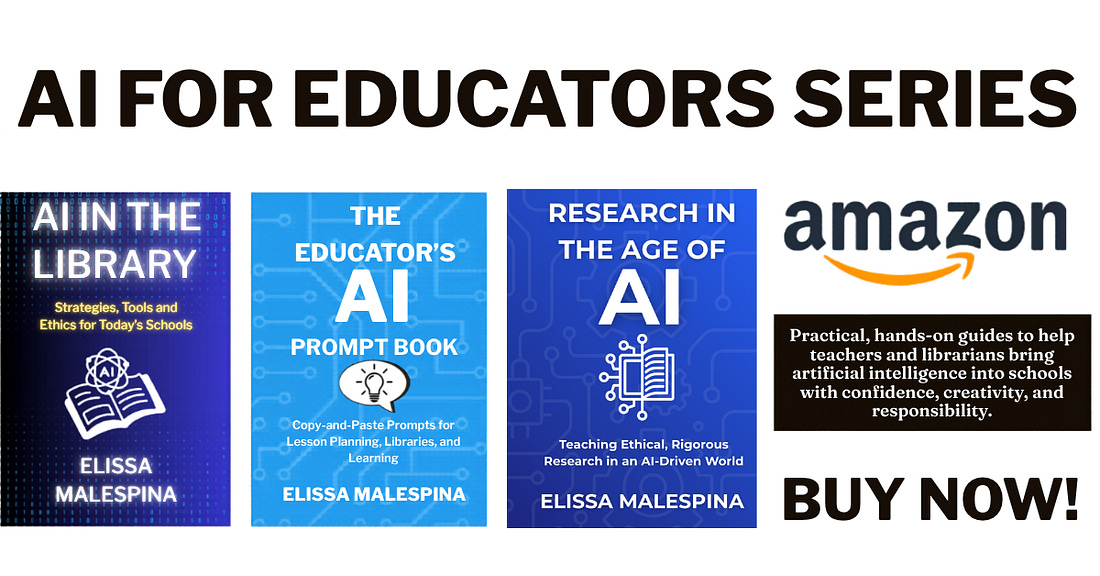
If this issue was useful, please consider supporting my work by purchasing my books in the AI for Educators Series on Amazon:
Closing
This week’s news shows that AI in education is entering a more demanding phase.
The conversation is no longer only about access to tools. It is about policy, procurement, search, homework, teacher preparation, assessment, screen time, and global governance.
For school librarians, that makes the work more urgent, not less.
Students need help understanding when information is trustworthy, when AI assistance becomes replacement, when a tool is shaping the answer, and when a human being needs to remain in the loop.
AI literacy is not a separate initiative. It is information literacy in a new information environment.
📘 The AI For Educators Series
Written by Elissa Malespina—now available in eBook and paperback!
AI in the Library: Strategies, Tools, and Ethics for Today’s Schools
The Educator’s AI Prompt Book: Copy-and-Paste Prompts for Lesson Planning, Libraries and Learning.
NEW - Research In the Age of AI: Teaching Ethical, Rigorous Research in an AI-Driven World
Portions of this newsletter are enhanced using AI-powered tools, with human review ensuring accuracy and quality.
Thank you so much for your support!
Like
Comment
Restack
© 2026 Elissa Malespina
South Orange NJ
Unsubscribe